
![]() |
International Indian Treaty Council CONSEJO INTERNACIONAL DE TRATADOS INDIOS |
|||||||
|
|
United Nations Commission on Human Rights Fifty-sixth Session March 20-April 28, 2000 Oral Intervention by the International Indian Treaty Council Agenda Item 12: Integration of the human rights of women and a gender perspective _____________________________________________________________________
Thank you Mr. Chairman
In our written intervention under this agenda item, the International Indian Treaty Council and the presented documented serious abuses, including examples of rapes and forced sexual subjugation, suffered by Indigenous women in Mexico at the hands of the military of that country. As we all know, the sexual and violent abuse of women and girls as a tactic of war, military occupation and political subjugation is not limited to that country. The IITC vehemently denounces these insidious and barbarous types of human rights violations wherever they occur around the world.
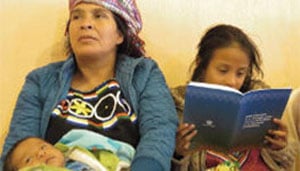
In the so-called developed and the developing countries alike, it is women and their children who are consistently most impacted by poverty, deprivation and lack of basic social services, including adequate health care and nutrition. Indigenous women, who occupy the lowest economic strata in virtually every country and society, suffer the most grievously.
Such ongoing, pervasive violations of human rights and human dignity have no place within the human family.
From February 28 – March 17th, at the United Nations Commission on the Status of Women , “ Beijing + 5 ” Prepcom in New York, Indigenous women representing communities, NGOs and organizations from the United States, Australia, Canada, Nicaragua, Guatemala, Nepal, Peru, Mexico, and Costa Rica presented the following Indigenous Women’ s Declaration, which the IITC has been requested to present for the consideration of this Commission as well:
“ The participation in the Beijing conference in 1995 and the adoption of the Platform for Action was an important turning point for the Indigenous women’ s movement, and we fully support its implementation. Few countries have reported any specific plans or programs for Indigenous women in this review of the progress towards implementing the Beijing Platform for Action.
However, Indigenous Peoples, especially women and girls, continue to experience exclusion, marginalization, and extreme poverty, and have had our rights and voices ignored.
Human development indicators reveal an increasing gap in the levels of impoverishment between Indigenous and non-indigenous peoples. Due to this growing gap, Indigenous Peoples continue to:
· have lower life expectancy, greater mortality from preventable diseases and malnutrition, higher HIV/AIDS rates, and greater infant and maternal mortality
· Less access to, and retention in, education systems, and higher levels of illiteracy
We also face appropriation of our lands and resources, and ongoing destruction of our traditional ways of life due to internal and external migration and displacement from our communities, caused by the imposition of neo-liberal economic policies, military occupation and aggression, and environmental destruction.
Due to the decline of our health, education, social, economic, cultural and political conditions, we must challenge institutionalized violence against our women and our nations to defend and preserve our way of life.
As Indigenous Peoples - like all other Peoples under international law - our inherent right to self-determination guarantees our ability to freely determine our political status and pursue our economic, social and cultural development. This includes our collective rights to land and territory, natural resources, biodiversity and intellectual property
We present the following recommendations:
1. We strongly urge governments to adopt, without further delay, the UN Draft Declaration on the Rights of Indigenous Peoples and to introduce national legislation to implement these rights.
2. We call for the ratification and implementation of all international instruments, including the ILO 169 convention on Indigenous rights, CEDAW, and the Convention on the Elimination of Racial Discrimination (CERD), that relate to the lives and conditions of Indigenous peoples, especially Indigenous women.
3. Recognizing the drastic poverty levels faced by Indigenous Peoples, and especially Indigenous women, we urge that the eradication of poverty amongst Indigenous Peoples be a priority, and that food security and access to culturally appropriate health programs and services be guaranteed.
4. We urge Governments to implement in full partnership with Indigenous Peoples formal and informal education programs for Indigenous women and girls that respect our history, languages, cultures, and aspirations.
5. We urge that Indigenous women fully participate in decision–making at all levels so that we are able to actively and effectively participate in policy decisions that affect us and our peoples.
6. Finally, the term Indigenous Peoples, with the “ S ”, must be used in all Beijing+5 documents, in recognition of our inherent collective rights as Peoples, as well as individual Human Rights as Indigenous women.
In conclusion, as Indigenous women, we struggle for peace, social and economic justice. We fight for and reaffirm the rights of Indigenous Peoples and our specific rights as Indigenous women. Most importantly, we must remember that INDIGENOUS RIGHTS ARE HUMAN RIGHTS” . Thank you. |
|
||||